
Expanding revenue is an essential objective for managed services firms. To achieve this, Managed Service Providers (MSPs) often prioritize the sales process to acquire new contracts and offer additional services to existing clients to meet revenue targets for the current month, quarter, or year.
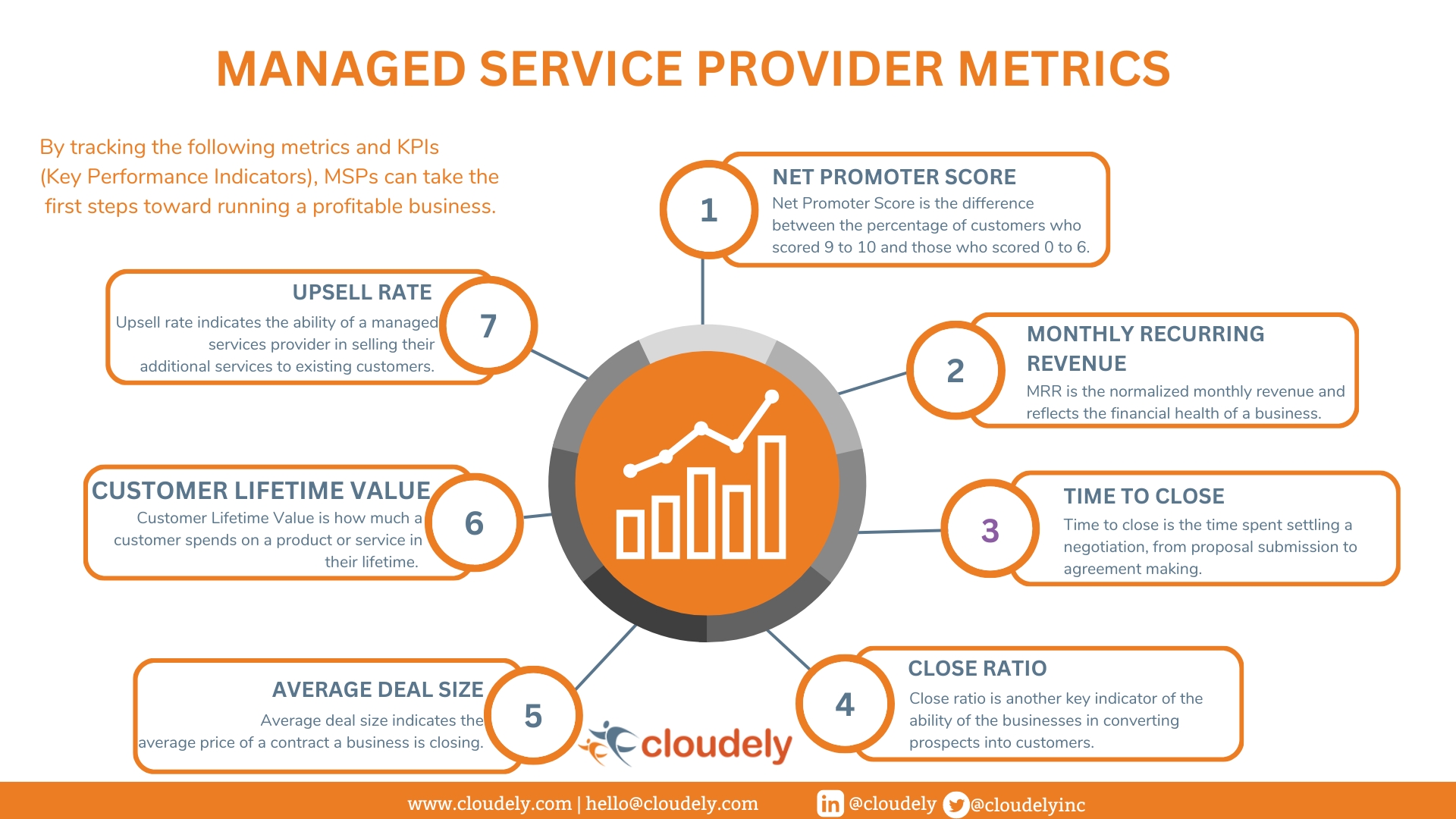
In this process, MSPs utilize a variety of tools and reports to help them gain perspective and prioritize their business goals. By tracking metrics and KPIs (Key Performance Indicators), MSPs can take the first steps toward running a profitable business.
Common Metrics That Help to Assess Managed Service Providers
Managed Services Provider metrics help evaluate and improve revenue growth plans and provide valuable insights to their sales teams, allowing them to make informed decisions, such as declining unfavorable deals or standing firm during proposal negotiations. This article discusses some crucial MSP metrics that help assess a managed service provider.
Net Promoter Score (NPS)
During your interactions with any business, if you have come across the question: “How likely are you to recommend us to a friend or colleague?”, you already experienced what NPS is.
An NPS or Net Promoter Score is a metric used to analyze the loyalty of consumers. It is a specific and quantifiable metric demonstrating consumers’ opinions of different brands. On a zero to ten scale, it segregates customers into 3 classes – Detractors, Passives, and Promoters.
Net Promoter Score is the difference between the percentage of customers who scored 9 to 10 (Promoters) and those who scored 0 to 6 (Detractors). The NPS calculation is simple and effective, making it a widely used managed services provider metric.
The NPS strategy, which depends on overview, gives bits of knowledge about client reliability by estimating their consideration to recommend a business to another.
NPS is an indicator of client loyalty and helps anticipate business growth. It is critical to note that different variables can make outright NPS scores less precise. Besides, this outright technique for deciding the NPS score is generic and is independent of the niche or the industry size.
MRR or Monthly Recurring Revenue
Monthly Recurring Value(MRR) is one of the widely used managed services provider metrics. MRR is the normalized monthly revenue of a business and reflects the financial health of a business. Any regular monthly source of revenue, such as subscriptions, renewals, discounts, coupons, and add-ons account for MRR. This metric does not consider the one-time fees and initial payments.
A simple formula to calculate MRR is:
MRR = No. of monthly subscribers * Average Revenue expected per subscriber.
MRR is a key managed services provider metric as it provides clear insights into the revenue potential of a business. Besides, its sub-classes such as Reactivation MRR, Churn MRR, Contraction MRR, etc. indicate the scope for business improvement.
Time to Close
Any business would want to close a deal in the minimal time possible. This deal closure time is measured by a metric called Time to Close.
Time to close is the time spent settling a negotiation, from proposal submission to agreement making. This key metric can assist businesses understand their vendor’s ability to successfully close a deal.
It also helps business owners plan for future negotiation cycles with new customers as it provides a tentative time for successful closure.
 Close Ratio
 Close Ratio
Linked to another MSP metric termed First-time appointments (FTAs), the Close ratio is another key indicator of the ability of the businesses in handling their first-time customers.
FTA indicates the success rate of the negotiation with first-time customers and converting them into revenue sources.
The close ratio is the ratio of FTA to the total number of customers. It also indicates the business value proposition, quality of leads, and sales efficacy.
Average Deal Size
Often businesses may have contracts of various revenue sizes. Average deal size indicates the average price of a contract a business is closing. By looking at the average deal size, you can assess if your Managed Service Provider can successfully handle your requirements. Average deal size also helps businesses understand their most profitable deal range.
Customer Lifetime Value
Customer Lifetime Value is how much a customer spends on your product or service in their lifetime.
To calculate customer lifetime value, consider the following parameters:
- The price of the service or product
- The count of the services or products
- The duration in months or years (based on the billing cycle)
By multiplying these factors, you can calculate the customer’s lifetime value.
Say, you offer a subscription-based service that costs $1000 per year. Your customer has been associated with your business and utilizing this subscription-based service for the past four years.
Now, the customer lifetime value becomes $1000 x 4 = $4000.
In case, the customer takes multiple subscription services, say 5, and assuming that each one costs $1000, then the customer’s lifetime value is $1000 x 4 x5 = $20000.
Upsell Rate
It is a proven fact that customers are open to trying new offerings from their existing vendors.
Upsell rate indicates the ability of a managed services provider in selling their additional services to existing customers. It tracks the number of products, services, or programs an MSP sells to existing customers beyond the initial interests.
Upsell rate is also helpful for businesses to analyze their services and offerings and focus on strengthening the ones that are fast-moving as up-sells.
Suggested Reading: How do Salesforce Managed Services Help Your Business?
Conclusion
Evaluating a managed services provider involves considering various factors. These MSP metrics discussed above help to reduce efforts in choosing the best provider for your service requirement. Note that metric evaluation is not a one-time deal and requires a deeper analysis based on the business niche.
Cloudely is a Salesforce Managed Services provider with a track record in offering competent services to clients. To maximize returns on your Salesforce investment, avail of our Managed Services. Email us at hello@cldystage.wpengine.com to receive our expert consultation.