
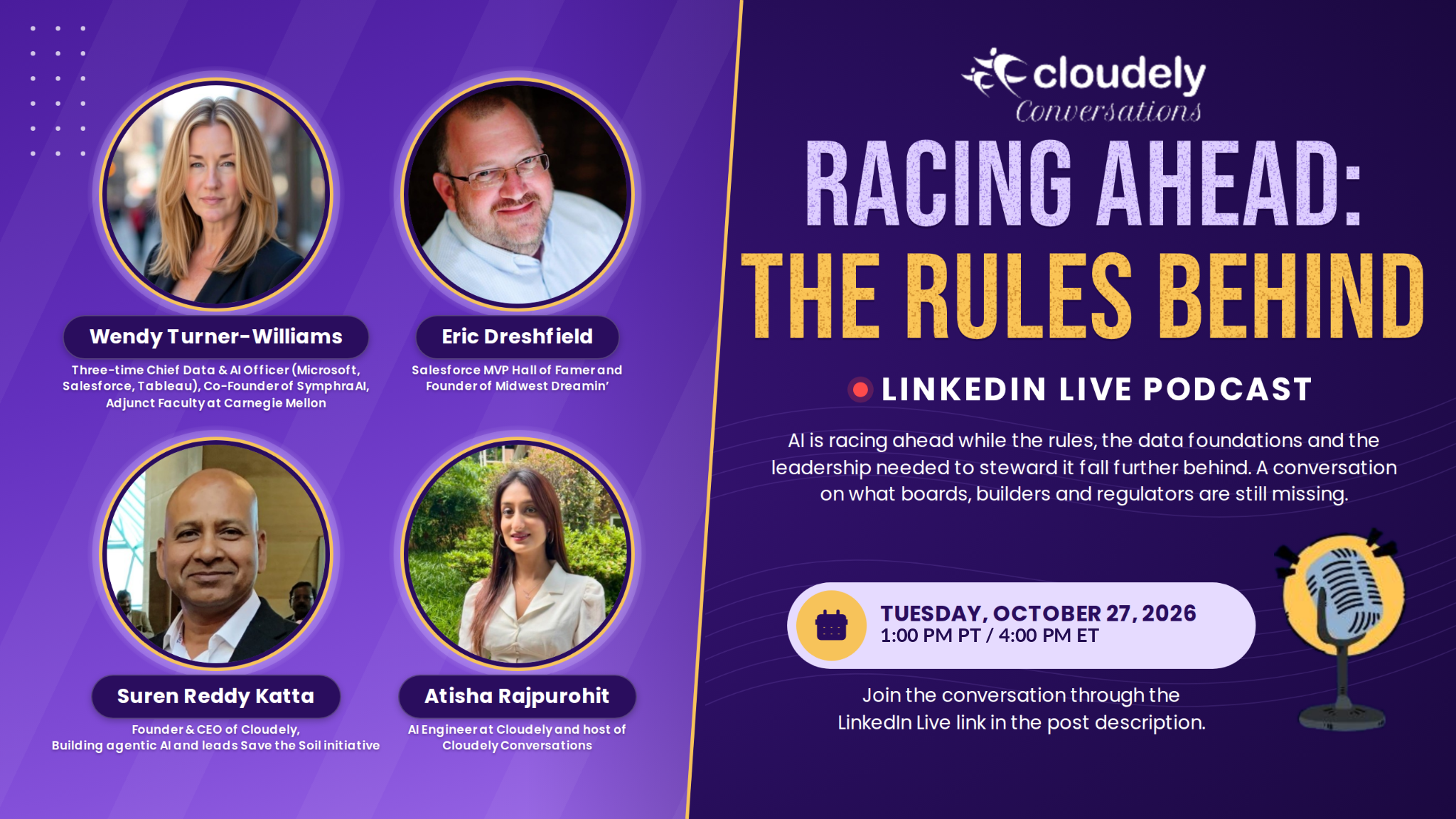
AI is racing ahead, but the rules, data foundations, and leadership needed to steward it are struggling to keep pace.
AI Leadership is becoming essential as companies navigate rapid AI adoption, data foundations, responsible innovation, and evolving global regulations.
In the third episode of Cloudely Conversations, Atisha Rajpurohit hosts Eric Dreshfield and Suren Reddy Katta to explore this gap from three perspectives: the boardroom, the practitioner community, and the CEO’s chair.
The conversation explores leadership and emotional intelligence in the AI era, why data is often the part organizations skip, what is happening with AI regulation and the EU AI Act, why data does not know a border, and the bigger picture that emerges when you zoom out.
What You’ll Take Away
Leadership in the AI Era
How leadership and emotional intelligence are evolving as AI becomes part of everyday business decisions.
The Data Foundation
Why data remains one of the most important and frequently overlooked parts of an AI strategy.
AI Regulation
A closer look at the evolving regulatory landscape, including the EU AI Act.
Data Without Borders
Why organizations need to think beyond geographic boundaries when managing and using data.
Boardroom to Practitioner
How perspectives differ across executives, practitioners, and business leaders navigating AI adoption.
The Bigger Picture
What becomes visible when AI, data, regulation, and leadership are considered together.
Speakers & Host
Wendy Turner-Williams
Speaker
Wendy has worked in AI since 2008 and has served in senior Data and AI leadership roles at Microsoft, Salesforce, and Tableau.
Eric Dreshfield
Speaker
Eric brings a practitioner and community perspective to the conversation around Salesforce, AI, and the evolving technology landscape.
Suren Reddy Katta
Speaker
Suren brings the CEO and business leadership perspective to the discussion around AI, data, and enterprise transformation.
Atisha Rajpurohit
Moderator
Atisha Rajpurohit moderates the conversation across AI, data, leadership, and emerging technology.
Who This Is For
This conversation is for business and technology leaders, AI and data practitioners, Salesforce professionals, executives, and anyone navigating the organizational, leadership, and regulatory questions surrounding enterprise AI.
It is particularly relevant for those looking beyond AI adoption to understand the role of data foundations, leadership decisions, and regulatory considerations.
Watch the Full Episode
AI is moving quickly, bringing new opportunities and challenges for business leaders, technology professionals, and organizations across industries.
In this episode of Cloudely Conversations, host Atisha Rajpurohit is joined by Salesforce ecosystem veteran Eric Dreshfield and Cloudely CEO Suren Reddy Katta to explore AI leadership, human accountability, data governance, emerging regulations, and the changing global business landscape.
Watch the full conversation to explore their perspectives on navigating the next phase of AI adoption.
Around the AI Kaleidoscope: Strategic Leadership, Human Interaction, and Global Markets
Since the emergence of new business opportunities and entrepreneurial innovation, digital transformation has brought significant changes to commerce and trade. Among these developments, artificial intelligence has emerged as one of the most influential forces shaping the business landscape.
As organizations increasingly explore AI, navigating its opportunities and challenges has become essential to fostering growth, accountability, and innovation. Rapid AI adoption is introducing new market trends, influencing governance across systems, raising questions about existing business strategies, and creating new pathways for career development.
At the heart of these developments lies an important question: Where is AI leading us?
In a recent episode of Cloudely Conversations, host Atisha Rajpurohit sat down with Salesforce ecosystem veteran Eric Dreshfield and Cloudely CEO Suren Reddy Katta. The discussion explored emerging trends, technology adoption, sustainable leadership, and the evolving role of businesses in the age of AI.
Taking the Lead in AI Strategies: Looking Beyond Short-Term Trends
As Silicon Valley and global markets increasingly place AI at the center of business discussions, human leadership remains essential to navigating organizational change.
The focus is shifting toward long-term business value rather than the excitement surrounding short-term technology trends.
Comprehensive Stakeholder Strategy
Effective leadership starts with a long-term vision. It involves understanding organizational assets and developing inclusive AI strategies that consider system administrators, partners, customers, and other stakeholders.
Involving people across closely connected workflows helps organizations manage complex assignments, coordinate responsibilities, and reduce the risk of unexpected operational challenges.
Practical Leadership Feedback Loops
Offline conversations, structured surveys, and email communication can help leaders gather feedback and maintain continuity across business operations.
These asynchronous communication channels provide opportunities to collect insights, identify actionable questions, and understand challenges that may not emerge through regular executive discussions.
Leadership teams can review this feedback to make informed decisions, adjust strategies, and guide future initiatives.
Outcome-Driven Investments and Human Accountability
The trend of companies downsizing teams to fund AI initiatives can sometimes reflect panic rather than a clear understanding of business outcomes.
Successful organizations need an outcome-driven framework that balances human talent with technological capabilities.
Reversing the Decision Framework
Traditional decision-making models often begin with trust, followed by human decisions, data, and outcomes.
An outcome-driven AI framework places greater emphasis on defining the desired results first. Organizations identify expected costs, pricing considerations, timelines, and business objectives before determining how AI can contribute.
Data Signal vs. Data Noise
AI relies heavily on high-quality data to function effectively.
As data streams multiply, organizations must distinguish meaningful data signals from background noise. Identifying relevant information helps support more reliable insights, better decision-making, and effective business intelligence.
Humans in the Loop
Autonomous AI agents cannot independently take legal or moral responsibility for organizational outcomes.
Human judgment and accountability remain essential for validating AI outputs, maintaining appropriate accuracy standards, and securing long-term stakeholder trust.
The discussion highlights accuracy expectations in the range of 95%–99%. However, the appropriate accuracy level depends on the specific application, its risk, and the evaluation criteria.
Re-Allocating Human Talent: The IKEA Example
Instead of eliminating customer support staff when introducing AI, organizations can consider reallocating employees to higher-value responsibilities.
The discussion references IKEA as an example of how AI adoption and employee reskilling can work together, shifting traditional customer support responsibilities toward more consultative roles.
The example also references a reported revenue figure of $1.4 billion, illustrating the broader business opportunity associated with combining technology and human expertise.
Emotional Quotient (EQ) and Community-Centric Adoption
Technical intelligence and smart code generation are no longer the only differentiators for organizational success.
Emotional intelligence, confidence, trust, and community engagement are also important in helping businesses adopt new technologies.
Building Confidence, Not Just Technology
Effective leaders build confidence and trust around technology rather than simply introducing new software.
Peer Communities Drive Adoption
Modern buying behavior and technology adoption are increasingly influenced by peer communities.
Professional networks and communities, including Salesforce ecosystem groups and RevGenius, provide opportunities for individuals to exchange experiences, share insights, and learn from one another.
Guiding Organizations Through Change
Leaders need strong emotional intelligence to guide employees and users through technological transformation.
Clear communication, empathy, and continuous engagement can help replace uncertainty and fear of automation with confidence and a positive outlook toward new opportunities.
AI Regulation, Guardrails, and Borderless Data
As advanced AI models continue to evolve, organizations face growing challenges in understanding and applying regulatory requirements across different regions.
Clear and Practical Language
Regulatory standards, including the EU AI Act and data protection frameworks such as CCPA and GDPR, need to be translated into practical organizational policies.
Employees, administrators, and technology teams should be able to understand how these requirements apply to their everyday workflows.
Borderless Data vs. Regional Laws
While states, provinces, and countries have geographical boundaries, digital information can move across borders through interconnected systems and applications.
Organizations operating internationally may encounter different or conflicting regulatory requirements when managing cross-border data.
Top-Down, Layered Guardrails
Effective governance requires broader organizational standards supported by context-aware local policies.
Structured review boards, similar to cross-functional Change Control Boards in IT, can evaluate risks, operational requirements, and safety evidence before AI applications enter production.
Context Transparency
System integrators that combine information from multiple systems must maintain transparency regarding data origins, processing flows, and user access.
This becomes particularly important in highly regulated areas such as healthcare and customer data privacy.
Cross-Industry Applications and Emerging Careers
AI adoption is rapidly expanding beyond traditional software environments, influencing established industries and creating opportunities for specialized hybrid roles.
Technology in Non-Technical Sectors
Retail
Employee reskilling can help shift traditional customer support responsibilities toward consultative roles and higher-value customer engagement.
Agriculture
Farming operations increasingly leverage technologies such as GPS, satellites, drones, and sensors to support better decision-making.
Multilingual voice agents can help bridge accessibility gaps by delivering localized information about crop selection, irrigation, and weather conditions directly to farmers in their preferred languages.
Emerging AI Roles
Forward Deployment Engineers (FDEs)
These roles combine deep technical expertise with an understanding of business requirements, implementation challenges, policy, and compliance.
AI Law and Policy Analysts
These professionals work at the intersection of AI architecture, legal review, regulatory requirements, and data governance.
Data Security Administration (DSA)
Drawing an analogy with the establishment of the Transportation Security Administration (TSA) after the September 11 attacks, the discussion considers whether future data governance challenges could lead to specialized regulatory bodies focused on data security, verification, and agent authorization.
This is a forward-looking possibility rather than an established regulatory structure.
Key Takeaways
Winning in the AI era is not about automating away human involvement.
Sustainable growth requires clarity over hype, outcome-first investments, robust data governance, and an emphasis on human emotional intelligence to build trust across teams, peer communities, and global markets.
Organizations that balance technological capabilities with human accountability, strategic leadership, and responsible governance will be better positioned to navigate the evolving AI landscape.
The future of AI will depend not only on how quickly businesses adopt new technologies but also on how thoughtfully they integrate them into their people, processes, and long-term strategies.
Continue the Conversation with Cloudely
The AI landscape continues to evolve, creating new opportunities and important questions for business and technology leaders.
Through Cloudely Conversations, we bring together industry professionals and business leaders to explore emerging technologies, share perspectives, and discuss the developments shaping the future of enterprise transformation.
Stay connected with Cloudely for more conversations on artificial intelligence, Salesforce, data, and business innovation.
Connect with Cloudely
Looking to explore AI, Salesforce, and digital transformation opportunities for your business?
Our team would be happy to understand your requirements and help you explore the right solutions.
Have a question or want to discuss a project? Submit an enquiry through our contact form.