
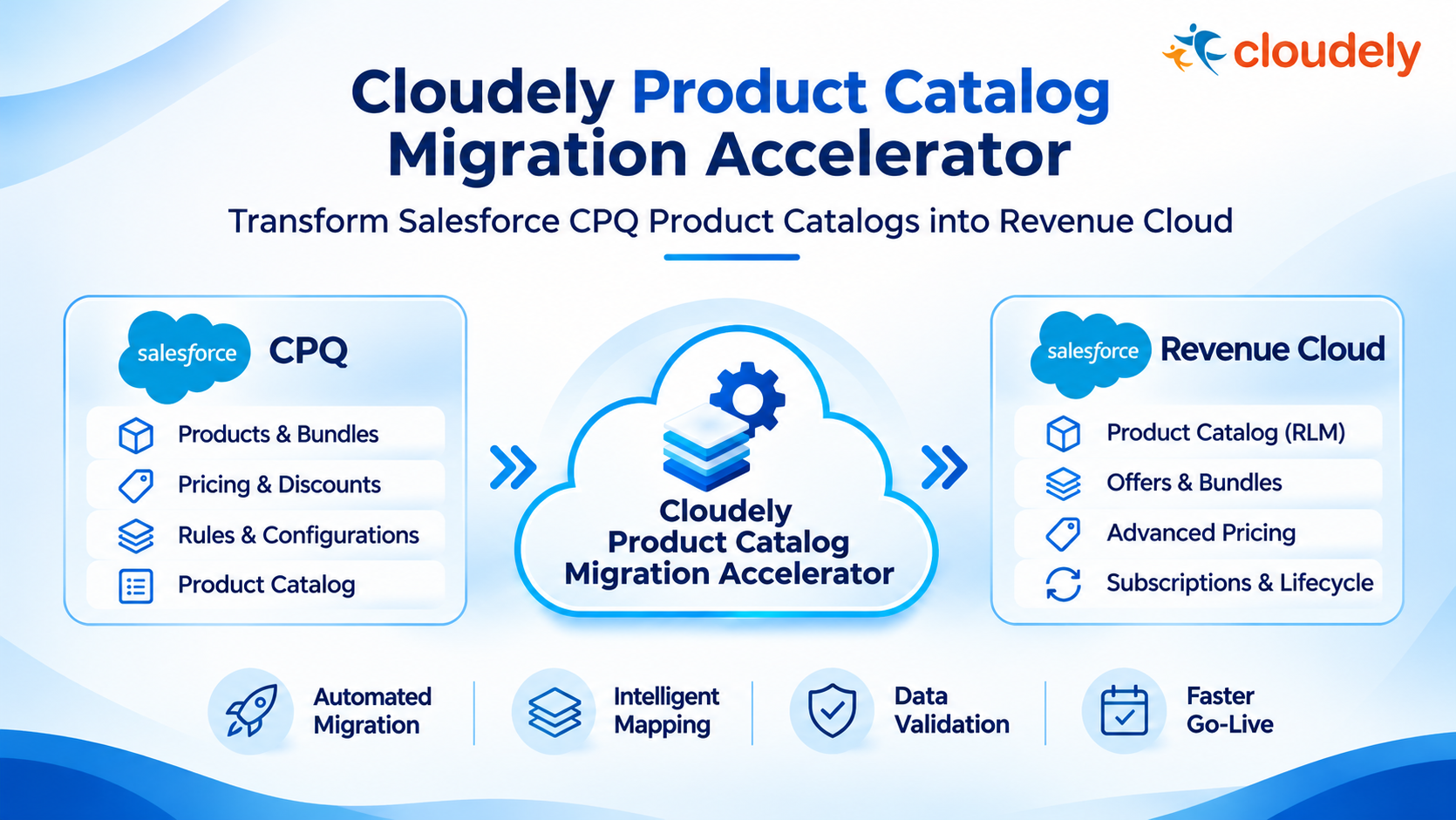
Introduction: Modernizing Product Catalog Management with Revenue Cloud
Product catalog management is one of the most important and technically challenging components of a Salesforce CPQ to Revenue Cloud migration.
Organizations using Salesforce CPQ often manage thousands of products, configurable bundles, product options, configuration attributes, product rules, and complex product relationships. Over time, these implementations can result in duplicated product records, SKU proliferation, fragmented configuration logic, and significant catalog maintenance overhead.
Salesforce Revenue Cloud introduces a more flexible Product Catalog Management architecture that supports reusable product classifications, dynamic attributes, product relationships, product categories, product bundles, and configurable selling models.
However, moving from Salesforce CPQ to Revenue Cloud is not simply a matter of transferring product records. It requires a structured transformation of the existing product data model, configuration architecture, and commercial product strategy.
Cloudely’s Product Catalog Migration Accelerator addresses this challenge through a structured, repeatable framework that helps enterprises assess, rationalize, transform, migrate, and validate their existing Salesforce CPQ product catalogs.
The objective is to establish a scalable, governed, and reusable product catalog architecture that supports modern quote-to-cash operations.
Organizations planning this transition can also explore Salesforce CPQ Transition to Revenue Cloud – Key Considerations to understand the broader migration considerations.
Understanding the Product Catalog Architecture: CPQ vs. Revenue Cloud
Salesforce CPQ and Revenue Cloud approach product catalog management differently.
Salesforce CPQ: Existing Architecture
Salesforce CPQ primarily uses Product2 records combined with managed-package objects to define product bundles, features, options, and configuration attributes.
Key components include:
- Product2 – Product master.
- SBQQ__ProductFeature__c – Product feature grouping.
- SBQQ__ProductOption__c – Bundle product options.
- SBQQ__ConfigurationAttribute__c – Product configuration attributes.
- SBQQ__OptionConstraint__c – Product option constraints.
- SBQQ__ProductRule__c – Product configuration and validation rules.
- Pricebook2 and PricebookEntry – Product pricing references.
This architecture can become difficult to maintain when organizations create separate SKUs for every product variation or use complex bundle structures to support configuration requirements.
Revenue Cloud: Modern Product Catalog Architecture
Revenue Cloud introduces Product Catalog Management capabilities designed around reusable product definitions and attribute-driven product models.
Key components include:
- Product2 – Product master.
- ProductClassification – Reusable product templates.
- AttributeDefinition – Reusable attribute definitions.
- AttributeCategory – Logical grouping of attributes.
- AttributePicklist and AttributePicklistValue – Attribute value management.
- ProductClassificationAttr – Attributes associated with product classifications.
- ProductAttributeDefinition – Product-specific attribute relationships.
- ProductCatalog – Catalog management.
- ProductCategory – Product categorization.
- ProductRelatedComponent – Product bundle composition.
- ProductComponentGroup – Bundle component grouping.
- ProductSellingModel – Product selling model.
The key architectural improvement is the ability to separate product characteristics from individual SKU definitions and reuse attribute structures across related products.
For a broader overview, explore Salesforce Revenue Lifecycle Management and its product catalog and configurator capabilities.
Cloudely Product Catalog Migration Accelerator
Cloudely’s accelerator provides an end-to-end approach to transforming existing Salesforce CPQ product catalogs into Revenue Cloud.
The solution is organized into six major capabilities.
Catalog Discovery and Assessment
Analyze the existing CPQ implementation, identify product structures, configuration attributes, product options, product rules, and dependencies.
Catalog Rationalization
Identify duplicate products, redundant bundles, unused SKUs, inconsistent product definitions, and opportunities for product consolidation.
Object and Field Mapping
Establish source-to-target object mappings, field transformations, relationship mappings, and data dependencies.
Product Configuration Transformation
Transform existing configuration attributes, product features, option constraints, and bundle relationships into the target Revenue Cloud architecture.
Migration Automation
Execute controlled product catalog migration using Salesforce APIs, transformation logic, dependency management, and batch processing.
Validation and Reconciliation
Validate product records, attribute definitions, product relationships, catalog structures, and configuration behavior.
Cloudely’s Salesforce implementation services cover Revenue Cloud implementation, product and price configuration, quoting, order management, billing, and integrations.
How the Cloudely Migration Architecture Works
The accelerator follows a structured migration pipeline:
Source Salesforce CPQ → Extraction → Catalog Intelligence → Mapping and Transformation → Migration Execution → Revenue Cloud → Validation
The architecture contains the following layers:
- Source system connectivity.
- CPQ product catalog extraction.
- Catalog intelligence and rationalization.
- Object and field mapping.
- Attribute and bundle transformation.
- Migration execution.
- Target Revenue Cloud Product Catalog Management.
- Validation and migration monitoring.
The design supports both lift-and-shift migrations and catalog rationalization initiatives.
Intelligent Product Catalog Assessment and Rationalization
Before migration, organizations must understand which products should be migrated, consolidated, redesigned, archived, or retired.
Cloudely’s Catalog Intelligence Engine evaluates the existing catalog against predefined assessment criteria.
Key Assessment Parameters
| Assessment area | Evaluation criteria |
|---|---|
| Product inventory | Active, inactive and obsolete products |
| Product duplication | Duplicate product codes and descriptions |
| Product variations | Products differing only by attributes |
| Bundle complexity | Nested bundles and option dependencies |
| Configuration attributes | Reusable and product-specific attributes |
| Product rules | Selection, validation and configuration logic |
| Product relationships | Parent-child and dependency relationships |
| Catalog governance | Product ownership and classification |
| Data quality | Missing values and inconsistent records |
Example: Product Rationalization
Consider a manufacturer maintaining different product SKUs for variations of an industrial cable.
Existing CPQ products
| Product | Characteristic |
|---|---|
| Cable-1M | Length: 1 metre |
| Cable-3M | Length: 3 metres |
| Cable-5M | Length: 5 metres |
Instead of maintaining separate products for every variation, the organization can evaluate a consolidated product model:
- Revenue Cloud Product: Industrial Cable
- Dynamic Attribute: Cable Length
- Permitted Values: 1M, 3M, 5M
This approach can reduce catalog duplication and simplify product maintenance.
However, consolidation must be evaluated against inventory, ERP, pricing, fulfilment, tax, and downstream SKU requirements. Distinct technical SKUs may still be required.
Transforming CPQ Configuration Attributes into Revenue Cloud Dynamic Attributes
One of the most important components of the migration is converting CPQ configuration attributes into Revenue Cloud’s data-driven attribute architecture.
In CPQ, configuration attributes frequently depend on custom fields and metadata.
Revenue Cloud supports reusable Attribute Definitions, Product Classifications, and Product Attribute records.
Example: Industrial Cable Product
Existing CPQ structure:
- Product A – 1.1 KV Copper XLPE.
- Product B – 1.1 KV Aluminium XLPE.
- Product C – 3.3 KV Copper PVC.
Proposed Revenue Cloud structure:
Product Classification: Industrial Power Cable.
| Attribute | Data type | Example values |
|---|---|---|
| Voltage Rating | Picklist | 1.1 KV, 3.3 KV, 11 KV |
| Conductor Material | Picklist | Copper, Aluminium |
| Insulation Type | Picklist | XLPE, PVC |
| Cable Size | Number or Picklist | 10, 16, 25 sq mm |
Products can inherit common attributes through their classification, while product-specific values and permitted selections can be configured independently.
This creates a reusable and scalable product definition model.
Product Bundle and Relationship Transformation
Salesforce CPQ represents bundles using parent products, Product Features, and Product Options.
Revenue Cloud introduces a structured component-based approach using Product Related Components and Product Component Groups.
Example: Industrial Installation Package
Existing CPQ bundle:
- Industrial Cable – Required.
- Installation Service – Optional.
- Testing Service – Optional.
- Warranty Extension – Optional.
The migration accelerator evaluates:
- Parent and child product relationships.
- Required and optional component selections.
- Minimum and maximum quantities.
- Component grouping.
- Nested bundles.
- Default selections.
- Product dependencies.
- Mutually exclusive selections.
The target bundle is then reconstructed using Revenue Cloud product component structures and the applicable Product Configurator logic.
The objective is to preserve the original business behavior while taking advantage of the new architecture.
Product Catalog Data Migration and Dependency Management
Migration must follow the target architecture’s object dependencies.
Cloudely’s migration engine uses a dependency-aware approach to ensure that referenced records exist before dependent records are created.
Recommended Migration Stages
A typical migration plan may include:
- Attribute categories and attribute definitions.
- Attribute picklists and picklist values.
- Product classifications.
- Product classification attributes.
- Product master records.
- Product attribute definitions and values.
- Product selling models and options.
- Product relationship types.
- Product component groups and related components.
- Product catalogs and categories.
- Product-category associations.
- Product qualification and configuration rules, as applicable.
The final execution sequence must be verified against Salesforce’s current deployment documentation and the enabled Revenue Cloud features.
Migration Controls
Cloudely’s framework supports:
- Source-to-target ID cross-referencing.
- External ID mapping.
- Batch migration.
- Duplicate detection.
- Error logging.
- Failed-record retry.
- Relationship validation.
- Record count reconciliation.
- Migration audit trails.
Migration Validation and Quality Assurance
Successful data loading does not necessarily mean successful catalog migration.
A product catalog must also work correctly during product discovery, configuration, quotation, and downstream fulfilment.
Cloudely recommends validating:
| Validation category | Expected result |
|---|---|
| Product records | In-scope records reconciled |
| Attribute definitions | Correct definitions and data types |
| Attribute values | Valid and complete values |
| Classification | Correct product inheritance |
| Product categories | Correct catalog organization |
| Product bundles | Correct component relationships |
| Quantity constraints | Correct minimum and maximum quantities |
| Selling models | Correct selling options |
| Product Configurator | Configuration scenarios work correctly |
| ERP compatibility | Required SKU and technical product mapping preserved |
Business scenario testing should include product selection, configuration, validation, quote creation, pricing, and order fulfilment.
For additional migration planning guidance, read Top 10 Considerations for a Successful CPQ to RCA Migration.
Cloudely Migration Delivery Methodology
Cloudely recommends a five-gate delivery methodology.
Gate 1 – Understand
Assess existing CPQ catalog architecture, product structures, attributes, bundles, dependencies, and data quality.
Gate 2 – Determine Scope
Define migration strategy, rationalization scope, target catalog architecture, and data mapping.
Gate 3 – Sandbox Migration
Build the target Revenue Cloud catalog and execute a representative migration proof of concept.
Gate 4 – Review and Analysis
Perform reconciliation, configuration testing, business validation, and migration exception analysis.
Gate 5 – Production Migration
Execute the approved migration, perform cutover validation, enable business users, and provide post-go-live support.
Business Benefits
Cloudely’s Product Catalog Migration Accelerator helps enterprises achieve:
- Reduced product catalog duplication.
- Improved product data consistency.
- Reusable product classifications.
- Simplified product attribute management.
- Standardized product configuration.
- Better bundle and relationship governance.
- Improved catalog scalability.
- More controlled migration execution.
- Improved integration readiness.
- A foundation for future Revenue Cloud capabilities and Agentforce.
Why Choose Cloudely?
Cloudely combines Salesforce implementation expertise, Revenue Cloud architecture, CPQ transformation experience, data migration, and enterprise integration capabilities.
Our approach focuses on understanding the customer’s existing business processes and redesigning the product catalog to support the future revenue lifecycle.
Rather than simply transferring legacy product records, Cloudely helps organizations establish a modern, governed, and scalable product catalog foundation.
Explore Cloudely’s Salesforce services to learn more about its Salesforce implementation and Revenue Cloud capabilities.
Transform your product catalog. Simplify your migration. Accelerate your Revenue Cloud journey.
Cloudely – Enabling the Next Generation of Salesforce Revenue Management.
Frequently Asked Questions
What is Salesforce CPQ to Revenue Cloud product catalog migration?
It is the process of transforming existing Salesforce CPQ product records, bundles, configuration attributes, and relationships into Revenue Cloud Product Catalog Management structures.
Can multiple CPQ SKUs be consolidated into a single Revenue Cloud product?
Yes. Where business, inventory, pricing, and fulfilment requirements permit, similar products can be consolidated using product classifications and dynamic attributes.
What happens to existing CPQ product bundles?
Existing bundles are assessed and transformed into Revenue Cloud product component structures, with applicable configuration rules and dependencies redesigned.
Can CPQ configuration attributes be migrated directly?
Not necessarily. Configuration attributes must be assessed and mapped to Revenue Cloud Attribute Definitions, Product Classifications, and Product Attribute structures.
Does the migration accelerator support large product catalogs?
The architecture can support high-volume catalog migrations through API-based extraction, dependency-aware processing, batching, reconciliation, and controlled execution. Actual capacity depends on org limits, data volume, and implementation design.
Does Cloudely support both lift-and-shift and catalog rationalization?
Yes. The accelerator can support migration with minimal catalog restructuring or a broader rationalization and transformation initiative.
Ready to Modernize Your Salesforce Product Catalog?
Planning a move from Salesforce CPQ to Revenue Cloud?
Connect with Cloudely to discuss your product catalog assessment, migration strategy, and transformation requirements.
Transform your product catalog. Simplify your migration. Accelerate your Revenue Cloud journey.
Submit Your Enquiry – Contact Cloudely
Our team can help you explore the right approach for your Salesforce CPQ to Revenue Cloud transformation.