
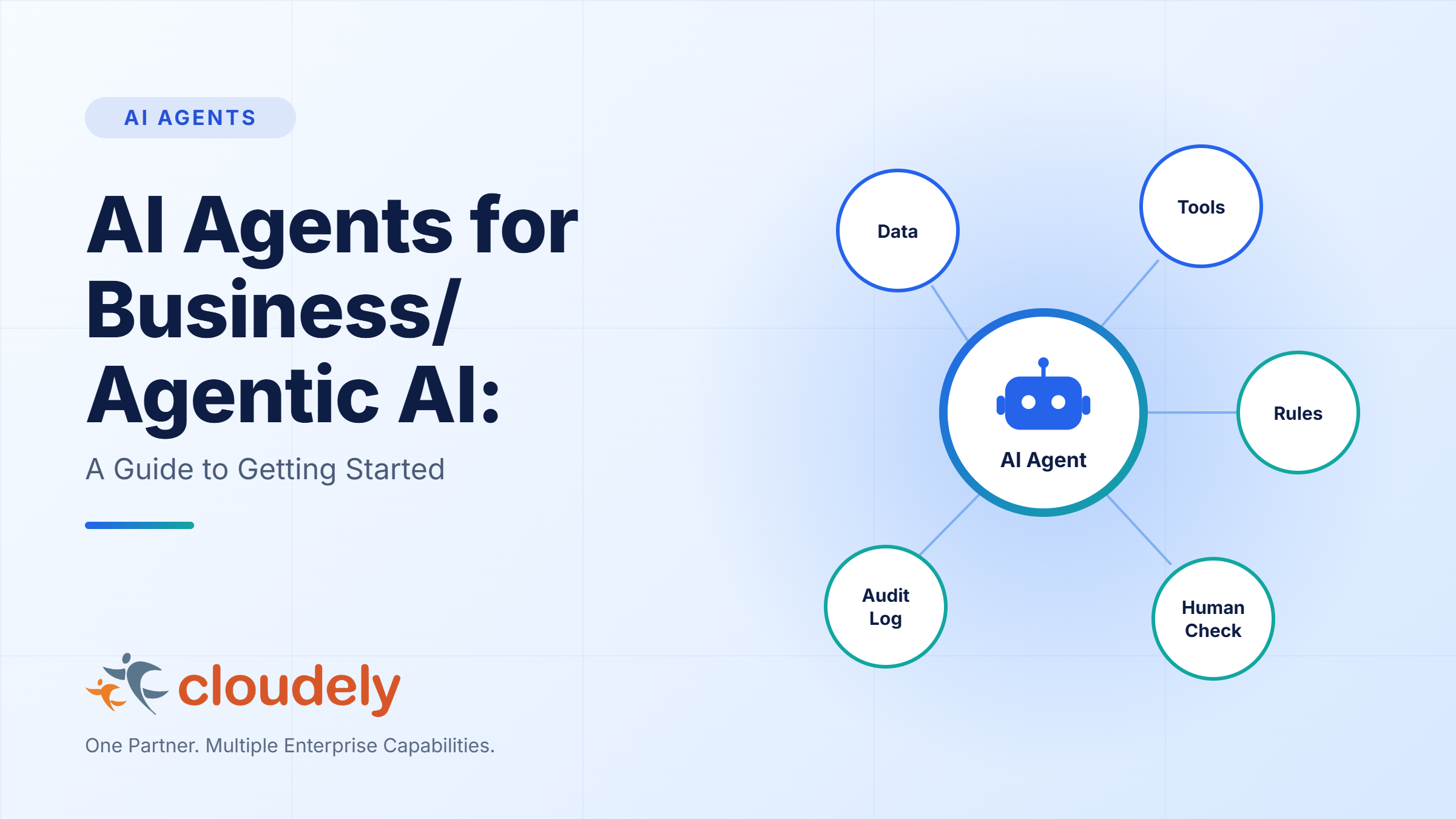
AI agents for business are transforming how organizations automate workflows, manage operations, and make smarter decisions. This guide explains what AI agents are, how they work, and how businesses can get started safely with intelligent automation.
Imagine hiring an intern who never sleeps, never complains about Monday, and can read a thousand emails before your coffee cools.
Sounds perfect. There’s just one catch. This intern follows instructions very literally, and will cheerfully do the wrong thing at lightning speed if you aren’t clear about the right one.
That, in a nutshell, is an AI agent.
Everyone seems to be talking about them. Far fewer people can explain what they are, what they’re good for, and where they go wrong. That’s a problem, because the businesses that get this right will save a lot of time, and the ones that rush will spend that time cleaning up.
This guide is the calm version. We’ll cover what agents are, what they can do, how they work, the risks to watch, and a simple plan for starting safely. No jargon, no hype.
What Are AI Agents for Business?
An AI agent is software that can understand a goal, look at the information it has access to, decide on the next step, and then actually do it. Not just suggest it. Do it.
That last part is the big difference.
A chatbot talks. An agent talks and takes action: it might update a record, send a follow-up, book a meeting or route a request to the right team.
Chatbot, Automation or Agent?
These three get mixed up all the time. Here’s the plain-English comparison.
| Basic chatbot | Rule-based automation | AI agent | |
|---|---|---|---|
| How it works | Replies from scripts or a knowledge base | Follows fixed “if this, then that” rules | Reads the situation and chooses a step toward a goal |
| Handles surprises | Poorly | Not at all | Reasonably well, within limits |
| Can take action | Rarely | Yes, but only the steps you set | Yes, using tools and data you give it access to |
| Needs clear rules | Some | Lots | Clear goals and boundaries |
| Best for | Simple FAQs | Repetitive, predictable tasks | Varied tasks that need judgment, with guardrails |
| Example | “What are your opening hours?” | “When a form arrives, email the manager.” | “Read this request, check the account, and resolve it or escalate it.” |
None of these is “best.” A simple rule is often the right answer. Agents shine when the work is messy and varies from one case to the next.
Why the Sudden Excitement?
Two things changed. AI got much better at understanding ordinary language, and platforms now let it work with your real business data and tools. Put those together, and the software can finally help with work that used to need a person to read, think and click.
What Can AI Agents for Business Actually Do?
The honest answer: a lot of the repetitive reading, sorting, checking and follow-up work that eats the day.
Here’s where teams commonly start.
| Department | What an agent can help with | What a person still does |
|---|---|---|
| Customer support | Answering common questions, looking up an order, drafting a reply | Handling upset customers and unusual cases |
| Sales | Summarizing a lead’s history, drafting follow-ups, updating records | Building relationships and closing the deal |
| Legal and contracts | Reading a contract, flagging unusual clauses, tracking renewal dates | Final review and negotiation |
| HR | Answering policy questions, collecting onboarding documents | Sensitive conversations and decisions |
| Operations | Routing requests, checking status, nudging overdue tasks | Exceptions and priorities |
| Voice and phone | Answering calls and handling routine requests, including in several languages | Complex or emotional calls |
See the pattern? The agent handles the routine in the middle. People keep the judgment, the relationships and the tricky edge cases.
A Few Ideas Worth Reading More About
Some of this is already being written about in detail. Cloudely, for example, has published material on multilingual voice agents and offers a free Legal AI Agent Blueprint for in-house legal teams. If contracts are your headache, its contract management services page is also worth a look.
Start With the Boring Work
Here’s a tip nobody puts in the press release. The best first project for an agent is usually the most boring one.
Pick something repetitive, high-volume and low-risk. A mistake there is cheap to fix, and a win there is easy to measure. Save the fancy, high-stakes ideas for later.
How AI Agents for Business Work: Behind the Curtain
Under the hood, a well-run agent follows a simple loop. It’s less mysterious than it sounds.
- A request comes in. A customer email, a form, a phone call, a task in a queue.
- The agent gathers context. It reads the request and looks at the data it’s allowed to see, such as the customer’s record.
- It decides on the next step. Using the goal and the rules you’ve set.
- It acts, or it asks. It does the task, or hands it to a person if it’s unsure.
- It keeps a record. What it did, and why, so people can review it later.
A good agent knows when to stop. The hand-off to a person isn’t a weakness. It’s a safety feature, and it’s what lets you trust the system with real work.
The Three Ingredients
- Data: what the agent is allowed to see. Clean, well-organized data makes it smarter.
- Tools: what the agent is allowed to do, such as update a record or send a message.
- Rules: what it must never do, and when it must ask a human.
Where Things Go Wrong (and the Guardrails That Help)
Agents are powerful, which means their mistakes can be powerful too. Here are the risks worth planning for, and the simple habits that keep them in check.
| Risk | What it looks like | A sensible guardrail |
|---|---|---|
| Wrong answers | The agent sounds confident but is mistaken | Limit it to approved data, and review samples regularly |
| Too much access | It can see or change more than it should | Give it only the access its job needs |
| No human check | A bad action runs unnoticed | Require approval for high-impact steps |
| Messy data | Old or duplicate records lead to bad decisions | Clean up key data before you start |
| No audit trail | Nobody can tell what happened | Log every action and the reason |
| Unclear ownership | Nobody is responsible when it fails | Name an owner for each agent |
| Customer trust | People feel tricked or stuck | Be open that it’s an AI, and offer a route to a person |
The Golden Rule
If an action would be expensive, embarrassing or hard to undo, a human should approve it first. If it’s cheap, easy to reverse and routine, let the agent run.
Your Safe-Start Checklist
- ☐ Pick one routine, low-risk process
- ☐ Write down the steps and where it can go wrong
- ☐ Decide what data the agent may see, and nothing more
- ☐ List the actions it may take, and the ones that need approval
- ☐ Set a clear hand-off to a person
- ☐ Test with real examples, including awkward ones
- ☐ Review its work every week at first
- ☐ Name one person who owns the result
Do It Yourself, Use a Platform, or Bring a Partner?
Once you know what you want, you have three common ways to get there.
| Build it yourself | Use an agent platform | Work with an implementation partner | |
|---|---|---|---|
| Who does the work | Your technical team | Your team, using the platform’s tools | Specialists working with your team |
| Speed to a first version | Slower | Faster | Fast, with experienced help |
| Skills needed | Strong AI and engineering skills | Some setup skills | Mainly knowing your own process |
| Fit with your existing systems | Whatever you build | Best when it matches the platform | Planned around your systems |
| Risk of mistakes | Higher, if it’s new to your team | Moderate | Lower, with experience behind it |
| Good for | Unusual needs and strong technical teams | Standard use cases | Teams that want results without a long learning curve |
The comparison describes typical patterns. Your situation may differ.
A Simple 60-Day Starter Plan
You don’t need a grand roadmap. You need a small, honest start.
| When | Focus | What “done” looks like |
|---|---|---|
| Days 1 to 10 | Choose and map | One routine process picked, with its steps written down |
| Days 11 to 20 | Prepare the data | The key records cleaned up and access agreed |
| Days 21 to 40 | Build and test | A first version tested on real examples, with hand-offs working |
| Days 41 to 50 | Pilot | A small group uses it, and you review every result |
| Days 51 to 60 | Review and decide | Time saved and mistakes counted, then a choice to expand, adjust or stop |
An honest review at day 60 is the secret. If it has worked, evolutionise it. If it didn’t, you’ve learned something cheaply.
How to Know It’s Paying Off
- Time per task goes down
- Response or resolution time gets faster
- Errors and rework drop
- People’s satisfaction, both staff and customers, holds steady or improves
- Hand-offs are smooth, and people trust them
Write the “before” numbers down first. You’ll be glad you did.
Where Cloudely Fits In
If you’d rather not learn all this the hard way, that’s where an implementation partner comes in.
Cloudely is a San Jose, California company that describes itself as a strategic implementation and consulting partner for enterprises that want to design, build and scale digital solutions. Its stated focus areas are no-code platforms, AI agents and cloud-neutral architectures. According to its site, it was founded in 2013, has 70+ customers and a team of 100+.
Matching Your Need to the Right Door
Here’s how common needs line up with what the site offers.
| If you need to… | Look at | What it is |
|---|---|---|
| Add AI agents to your business | AI Solutions | AI agents and chatbots, plus a marketplace of reusable agents and applications |
| Put Salesforce’s AI agents to work | Agentforce Implementation | Help planning and rolling out Agentforce |
| Set up or improve Salesforce | Salesforce Implementation | Salesforce implementation services |
| Speed up contracts | Contract Management | Contract management services |
| Plan a broader tech rollout | Technology Implementation | Implementation services for new technology |
| Build business apps without heavy coding | Konfeeg | A no-code platform for apps, workflows and approvals |
| Build skills in your team | Training | Salesforce training |
| Add specialist people | Staffing | Staffing services |
Keep Learning
Prefer to read first and talk later? The Cloudely blog and Learning Hub are good places to start. Recent posts cover topics like agentic AI and Konfeeg and moving from Salesforce CPQ to Revenue Cloud.
Quick Answers to Common Questions
What is an AI agent in simple terms?
It’s software that can understand a goal, look at the data it can access, decide on the next step and take action, rather than just answering questions.
How is an AI agent different from a chatbot?
A chatbot mainly talks. An agent can also act, such as updating a record, sending a message or routing a request, within the limits you set.
Are AI agents safe to use in a business?
They can be, with guardrails: limited access, human approval for high-impact actions, a clear hand-off to a person, and a record of what the agent did.
Will AI agents replace my team?
They’re best at routine, repetitive work. People still handle judgment, relationships and unusual cases, and they supervise the agent.
What should I automate first?
A routine, high-volume, low-risk task. Mistakes are cheap to fix and results are easy to measure.
Do I need a partner to get started?
Not always, but experienced help can shorten the learning curve, especially when agents need to work with systems like Salesforce.
The Bottom Line
AI agents aren’t magic, and they aren’t a threat. They’re a very fast, very literal helper that does best with clear instructions, good data and a person nearby to catch the odd surprise.
Start small. Pick something boring. Set the rules, keep a human in the loop, and count the results.
Do that, and you’ll be miles ahead of the folks who bought the shiny thing first and wrote the instructions later.
Your Move
Your future intern doesn’t need a desk, a laptop or a parking space. Just a clear brief and someone who knows where the traps are.
Good news: we know a few people who do. Talk to Cloudely’s experts and tell them what’s eating your team’s week. They’ll help you figure out whether an agent is the answer, or whether you just need a better spreadsheet. (We won’t tell anyone which.)