
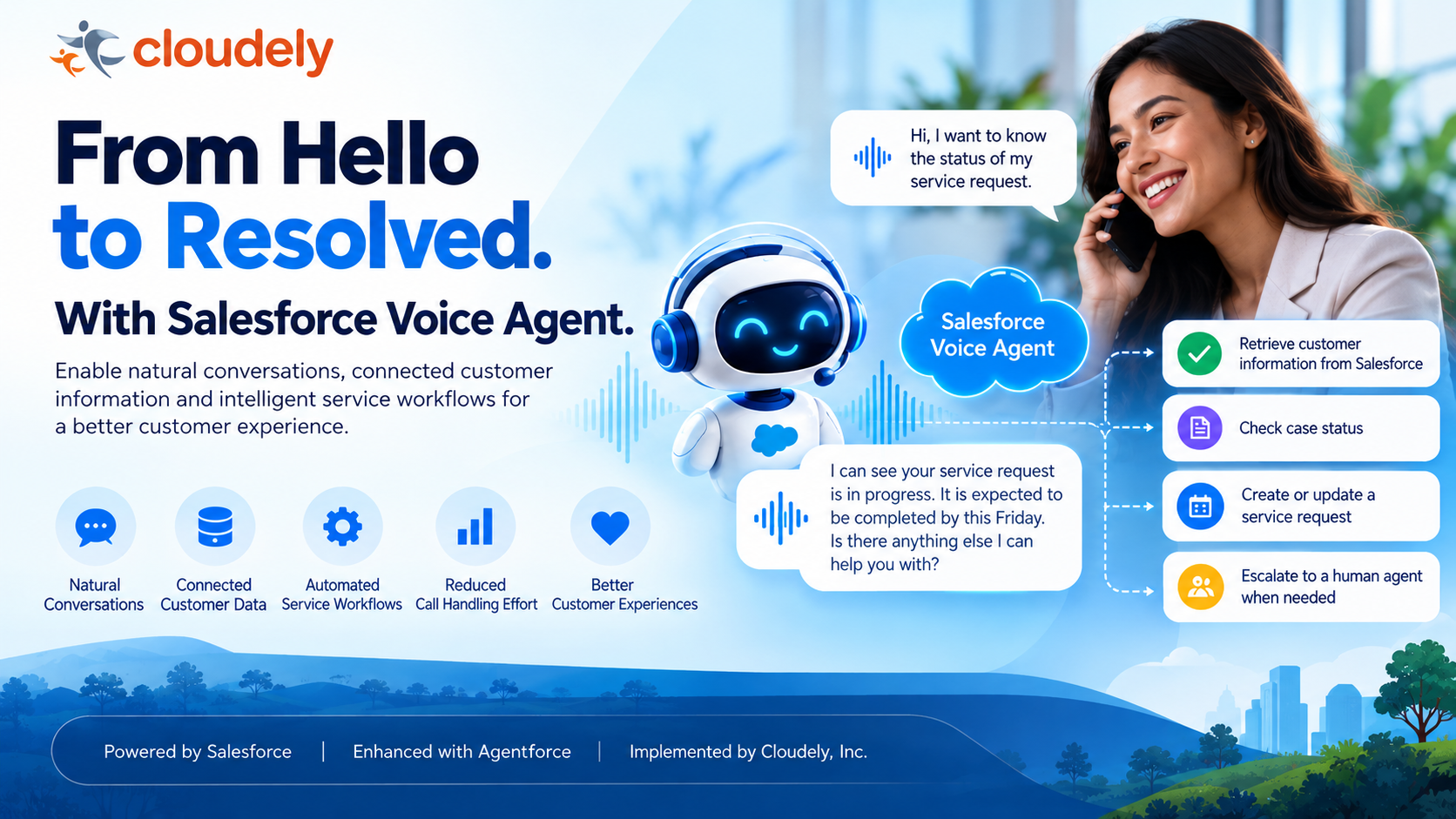
How Salesforce Voice AI can transform customer conversations through natural interactions, connected customer information and intelligent service workflows.
Think about the last time you called a customer support number.
You listened to a list of options, pressed a few numbers, entered your details and waited. When you finally reached a representative, you had to explain your problem all over again.
For customers, this is frustrating.
For businesses, it creates additional call handling effort, repetitive conversations and unnecessary pressure on contact center teams.
Traditional IVR systems have served organizations for years. They help route calls and manage high volumes of enquiries. But customers increasingly expect something different.
They want to explain what they need in their own words and receive a relevant response without navigating complicated menus.
This is where Salesforce Voice AI and Agentforce Voice capabilities can change the customer service experience.
Why Traditional IVR Is No Longer Enough
Traditional IVR systems generally depend on predefined menus and routing rules.
They work well for straightforward scenarios, but become less convenient when customers have complex or unexpected requests.
Consider some common challenges:
- Too many menu options: Customers spend time navigating menus before reaching the right service.
- Repeated information: Customers may need to provide the same details to different representatives.
- Disconnected systems: Voice interactions may not have immediate access to relevant CRM information.
- Manual service activities: Representatives spend time creating cases, updating records and documenting conversations.
- High volumes of repetitive enquiries: Service teams handle routine questions that could potentially be automated.
- Limited interaction visibility: Businesses may struggle to convert conversations into useful service insights.
The result is a contact center that spends too much time handling repetitive activities instead of focusing on meaningful customer interactions.
Introducing Salesforce Voice Agent
Salesforce Voice Agent capabilities bring conversational AI into customer interactions.
Instead of relying only on keypad-based menu selection, customers can communicate their requirements naturally.
Depending on the selected Salesforce capabilities and implementation architecture, a voice-enabled AI agent can:
- Understand customer requests.
- Identify the intent behind a conversation.
- Retrieve relevant customer information.
- Respond using approved business information.
- Initiate supported service workflows.
- Escalate conversations to human representatives when needed.
The real opportunity is not simply allowing customers to talk to AI.
It is connecting those conversations with the information and business processes required to resolve customer needs.
How Does a Salesforce Voice Agent Work?
Let’s walk through a typical customer service interaction.
1. The customer initiates a conversation
A customer calls the organization’s support number with a question or service request.
The configured voice experience receives the interaction.
2. The agent understands the customer’s request
The customer explains the issue using natural language.
The Voice Agent processes the conversation and identifies the customer’s intent.
For example:
“I want to know the status of my service request.”
The agent recognizes that the customer is asking for case-status information.
3. The solution retrieves relevant Salesforce information
Using authorized access and configured integrations, the solution can retrieve relevant information from Salesforce.
This may include:
- Customer and account details
- Existing service cases
- Case status and priority
- Relevant service history
- Approved knowledge information
Access must follow the organization’s authentication, authorization and data protection requirements.
4. The agent responds or initiates an action
Based on the customer’s request and the capabilities configured for the solution, the agent can provide relevant information or initiate a supported action.
For example:
- Check the status of an existing case.
- Create a service request.
- Capture a new enquiry.
- Initiate an appointment workflow.
- Route the conversation to an appropriate service team.
5. Human assistance when required
Not every customer request should be handled entirely by AI.
When a conversation involves a complex issue, sensitive information or an action outside the agent’s authorized capabilities, the interaction should be escalated to a human representative.
Where supported, relevant conversation context can be passed along to reduce the need for customers to repeat themselves.
6. Capture interaction information
The configured solution can record appropriate interaction details, summaries and follow-up activities in connected systems.
This provides service teams with better visibility into customer conversations and subsequent actions.
Five Practical Use Cases for Salesforce Voice AI
1. Customer Service and Case Management
Customers can explain their problems naturally.
The Voice Agent can identify the issue, retrieve relevant case information and initiate case creation or escalation workflows where configured.
2. Order and Delivery Enquiries
Customers frequently call businesses to check order status and delivery information.
A voice-enabled agent can retrieve available information from connected Salesforce or enterprise systems and provide relevant updates.
3. Appointment Scheduling
Customers can enquire about available appointments, request changes or initiate scheduling activities.
The solution can connect with configured scheduling workflows and systems.
4. Sales Enquiries and Lead Capture
A prospective customer calls to enquire about a product or service.
The Voice Agent can collect relevant information, understand the enquiry and initiate a lead creation or sales follow-up workflow.
5. Service Request Routing
Not every enquiry requires the same service team.
The agent can identify the request type and route the interaction according to configured business rules and service processes.
A Practical Example: From a Phone Call to a Salesforce Case
Imagine a customer calling an automobile dealership’s service center.
The customer wants to know the status of a vehicle service complaint.
In a traditional process, the customer may navigate an IVR menu, wait for a representative and explain the issue again.
With a configured Salesforce Voice Agent experience:
- The customer explains the service enquiry naturally.
- The agent identifies the request as an existing service-case enquiry.
- The solution verifies the customer according to the configured authentication process.
- Relevant case information is retrieved from Salesforce.
- The agent communicates the available update.
- If the customer needs additional assistance, the interaction is transferred to a service representative.
- Relevant interaction details are captured for follow-up.
The result is a more connected service experience, with less repetitive information gathering.
The Importance of Salesforce Integration
A voice agent becomes significantly more useful when it can work with relevant business information and service processes.
Depending on the selected architecture, Salesforce Voice capabilities can be connected with:
Service Cloud: For customer cases, service workflows and knowledge.
Sales Cloud: For customer enquiries, lead capture and sales follow-up.
Salesforce Contact Center capabilities: For supported contact center and voice workflows.
Agentforce: For configured AI agent reasoning, actions and business process execution.
Enterprise systems: For order, delivery, appointment and other information that may reside outside Salesforce.
The exact capabilities depend on the Salesforce products selected, licensing, telephony architecture, integrations and implementation design. These capabilities should be validated during solution discovery.
What Businesses Should Consider Before Implementing Voice AI
A successful implementation requires more than configuring a conversational AI experience.
Organizations should consider:
- Voice channel and telephony integration.
- Salesforce licensing and supported voice capabilities.
- Customer authentication and identity verification.
- CRM data quality and access permissions.
- Integration with case, order and appointment systems.
- Human handoff and escalation processes.
- Privacy, consent and call recording requirements.
- Testing, conversation quality and operational monitoring.
It is also important to define which actions the AI agent can perform independently and which require customer confirmation or human approval.
How Cloudely Can Help
At Cloudely, we believe the next generation of customer service should connect conversations with business outcomes.
Our Salesforce implementation approach can help organizations assess and design voice-enabled customer experiences around their existing Salesforce environment.
This can include:
- Voice solution discovery and architecture.
- Salesforce Service Cloud integration.
- Agentforce and conversational workflow design.
- CRM data and enterprise system integration.
- Case creation and service automation.
- Human escalation and handoff design.
- Security, governance and testing.
- Deployment and continuous improvement.
We focus on building solutions that fit real business processes rather than introducing AI simply for the sake of automation.
The Future of Customer Conversations Starts with Better Experiences
Customers do not care how many systems operate behind the scenes. They care about getting the right answer without unnecessary effort.
Voice AI creates an opportunity to make customer interactions more natural, connect conversations with relevant information and help service teams work more effectively.
The next step is not necessarily replacing every traditional IVR workflow. It is identifying where conversational AI can make the biggest difference.
Is your organization ready to move beyond traditional IVR?
Connect with Cloudely to explore Salesforce Voice AI capabilities and identify practical opportunities to modernize your customer service operations.
Email: salesforce@cloudely.com
Cloudely, Inc. | Salesforce Transformation | AI & Agentforce Solutions