
A managing partner emails the whole firm on a Monday: “We’re rolling out an AI agent for contract review this quarter.” By Friday, three associates have quietly pasted a confidential client agreement into a consumer tool to “test it out,” nobody can say where that data went, and the firm’s malpractice carrier hasn’t been told a thing.
That sequence plays out more often than most leaders admit. The technology is ready. The decision-making around it frequently isn’t.
Before you sign a contract or greenlight a pilot AI agent in legal practice, it’s worth slowing down long enough to answer a handful of questions that separate a successful rollout from an expensive, reputation-denting mess.
Key Takeaway
An AI agent can meaningfully improve efficiency and accuracy across legal workflows, including document review, legal research, contract analysis, and client intake.
But success depends on getting six fundamentals right: Data security, Human oversight, Accuracy verification, Workflow integration, Cost and ROI, Governance and accountability
Deploy on top of those foundations, not before them.
First, What Does “An AI Agent” Actually Mean in a Legal Practice?
It’s worth being precise, because the term gets stretched.
A basic chatbot answers a question.
An AI agent (sometimes called agentic AI) goes a step further:
- Plans a multi-step task
- Executes the workflow
- Checks its own progress
- Uses external tools where needed
Powered by Large Language Models (LLMs) trained on legal and natural language data, an agent can:
- Read large volumes of documents
- Extract relevant clauses
- Cross-reference case law
- Produce first drafts
This kind of connected, multi-stage work is something older automation simply couldn’t do.
That capability is exactly why the pre-deployment questions matter.
An agent that can act on your behalf can also err on your behalf.
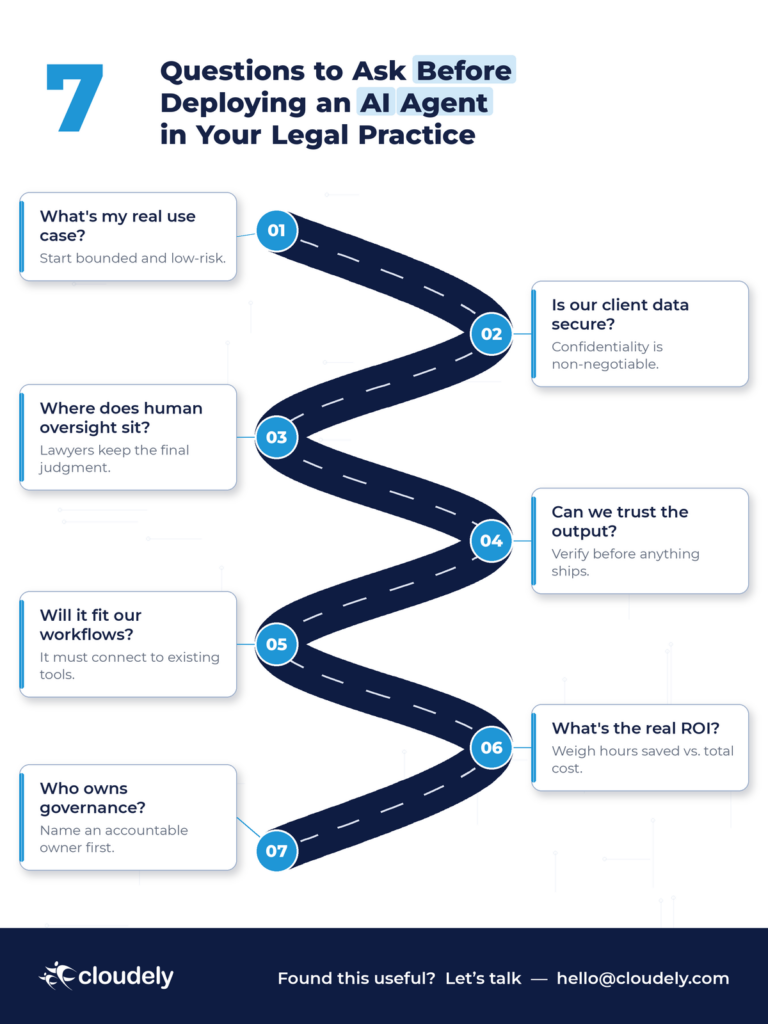
1. Is This AI Agent Use Case Genuinely a Fit?
Start with the workflow, not the software.
Strong first use cases
- Deposition summaries
- First-pass document review
- Contract analysis against standard templates
- E-discovery triage
- Legal research synthesis
These build institutional confidence because mistakes are:
- Easy to detect
- Low risk
- Recoverable
Poor first use cases
Avoid beginning with:
- Bespoke legal matters
- High-stakes decisions
- Judgment-heavy work
If being wrong is unacceptable, choose another starting point.
2. How Will You Protect Client Confidentiality and Data Security?
This question ends most rushed deployments.
Consumer AI tools may:
- Route data through unknown systems
- Store information outside your control
- Use prompts for model training
For law firms, that’s unacceptable.
Before deployment, confirm:
- Where data is processed
- Where data is stored
- Whether client information trains external models
- Encryption standards
- Compliance with legal confidentiality obligations
3. Where Does Human Oversight Sit?
An AI agent supports lawyers. It does not replace them.
Before deployment, define:
- Who reviews outputs?
- At what stage?
- Who signs off before client delivery?
- What decisions can the AI make?
- When must it stop and ask?
If your firm can’t draw these checkpoints on a whiteboard, it isn’t ready to implement them in production.
4. Can You Actually Trust the Output?
LLM-powered agents can produce answers that are: Fluent, Confident, and Wrong. Including fabricated citations. Build verification into the workflow.
Ask:
- Are citations traceable?
- Are sources verifiable?
- Has the model been validated using legal benchmarks?
- Is every output reviewed before use?
Treat the AI like a capable junior associate whose work always requires review, never as an oracle.
5. Will It Integrate With Your Existing Workflows?
An AI agent should work where your lawyers already work.
Not in another isolated application.
The value comes when it integrates with:
- Document management systems
- Research platforms
- Case files
- Existing legal workflows
Otherwise, it simply creates another login.
6. What’s the Real Return, and What’s the Real Cost?
Don’t stop at licensing fees.
Consider:
- Implementation
- Integration
- Security
- Training
- Human oversight
Compare those costs with:
- Hours saved
- Errors avoided
- Lawyer productivity
- Strategic work enabled
The real question isn’t: “Is this impressive?”
It’s: “Does this free our lawyers to do the work only lawyers can do?”
7. Who Owns Compliance, Ethics, and Accountability?
Someone must own governance.
Before deployment, define:
- Approved AI tasks
- Ethical boundaries
- Compliance standards
- Escalation procedures
- Accountability
Name the responsible person or committee before launch.
Governance created after an incident is simply damage control.
AI Agent for Legal Teams Readiness Self-Check
Score one point for every Yes.
| Readiness Signal | Yes / No |
| We’ve chosen a bounded, low-catastrophe use case to start | |
| We know where client data goes and it stays confidential | |
| Human review checkpoints are defined and assigned | |
| Every output can be verified against a trusted source | |
| The agent integrates with our existing legal workflows | |
| We can state the expected ROI in hours or dollars | |
| A named owner is accountable for governance and ethics |
Results
| Score | Readiness |
| 6–7 Yes | Ready to pilot confidently |
| 4–5 Yes | Close the gaps first |
| 0–3 Yes | Finish your strategy before deployment |
The Mistakes That Trip Firms Up
Most failures are implementation failures. Common mistakes include:
- Deploying firm-wide immediately
- Skipping confidentiality reviews
- Trusting AI output without verification
- Using consumer AI instead of professional platforms
- Failing to assign accountability
Each one is preventable before launch.
Frequently Asked Questions
Will an AI agent replace lawyers?
No.
It automates repetitive work such as:
- Formatting
- First-pass review
- Research synthesis
Lawyers continue to provide:
- Judgment
- Strategy
- Client advice
- Professional responsibility
What’s the safest place to start?
Choose:
- Deposition summaries
- First-pass contract review
- E-discovery triage
These deliver value while keeping risk manageable.
Is client data safe?
Only when using enterprise-grade AI designed for confidential legal work.
Always verify:
- Data location
- Model training policies
- Encryption
- Compliance standards
How much oversight is required?
A qualified lawyer should review every output before it reaches:
- Clients
- Courts
- Opposing counsel
AI can automate workflows.
Legal judgment remains human.
Conclusion
Successful AI adoption in law isn’t about deploying technology first. It’s about deploying governance first.
The firms that benefit most from AI agents aren’t necessarily the ones adopting earliest. They’re the ones asking the right questions before implementation and building workflows where technology enhances, rather than replaces, legal expertise.
About Cloudely Inc.
At Cloudely Inc, we hold immense experience in designing AI Agents for the Legal Industry, helping firms move from cautious pilots to confident, compliant deployments.
Whether you’re evaluating your first AI initiative or scaling across multiple legal workflows, we can help you build AI agents that align with your firm’s processes, data, and professional obligations. Contact us.