
The legal profession has always been built on expertise, precision, and trust. Yet, behind every successful case lies an enormous amount of repetitive work: reviewing documents, researching precedents, drafting contracts, organizing evidence, and responding to client queries.
Industry analysts project the market for generative AI in the legal sector to reach nearly $780 million by the early 2030s, while some estimates suggest AI could automate the equivalent of 100,000 legal roles’ worth of routine tasks over the next decade.
Those figures are impressive, but they rarely convince managing partners or practice heads. What does? Real-world applications.
Today, AI agents are helping law firms reduce administrative workloads, accelerate legal research, improve document accuracy, and deliver faster client service. They are not replacing lawyers. Instead, they are handling repetitive, process-driven work so legal professionals can focus on strategic thinking, negotiations, advocacy, and client relationships.
Before exploring the AI agent use cases for law firms, it helps to understand what an AI agent actually is.
What Is an AI Agent in Legal Practice?
Unlike a traditional chatbot or search engine, an AI agent can execute an entire workflow.
Powered by Large Language Models (LLMs), Natural Language Processing (NLP), and workflow automation, AI agents can:
- Read legal documents
- Understand context
- Extract important information
- Compare contracts
- Conduct legal research
- Draft documents
- Summarize lengthy case files
- Trigger business workflows
Rather than simply answering questions, AI agents for legal perform multi-step legal tasks while keeping attorneys in complete control of every decision.
Group A: AI Agents for Document Reading and Review
1. First-Pass Document Review
Large litigation matters often involve thousands of documents.
AI agents automatically classify documents based on:
- Relevance
- Confidentiality
- Matter type
- Risk level
- Potential inconsistencies
Instead of manually sorting files, lawyers receive prioritized documents that require their expertise.
Benefits
- Faster review cycles
- Reduced human error
- Better prioritization
- Lower review costs
2. E-Discovery at Scale
Traditional keyword searches frequently miss critical evidence hidden within conversations.
AI agents understand:
- Context
- Intent
- Relationships
- Sentiment
- Conversation flow
They can analyze millions of emails, messages, PDFs, and attachments to surface the evidence most relevant to litigation.
Benefits
- Improved evidence discovery
- Faster litigation preparation
- Reduced manual review
- Better legal outcomes
3. Key Information Extraction
Every legal document contains structured information that lawyers repeatedly enter into internal systems.
AI agents automatically extract:
- Names
- Dates
- Parties
- Clauses
- Obligations
- Deadlines
- Definitions
The extracted information can then populate document management systems, case management platforms, or legal CRMs automatically.
Benefits
- Eliminates repetitive data entry
- Improves data accuracy
- Saves billable hours
- Standardizes documentation
Group B: AI Agents for Legal Research and Analysis
4. Deep Legal Research and Analysis
Legal research often spans statutes, regulations, judgments, legal journals, and secondary sources.
AI agents analyze these resources simultaneously and understand legal context instead of relying solely on keyword matching.
Benefits
- More comprehensive legal research
- Stronger legal arguments
- Faster preparation
- Improved confidence in findings
5. Case Law Pattern Analysis
Instead of reviewing hundreds of historical judgments manually, AI agents identify:
- Legal trends
- Frequently cited precedents
- Judicial reasoning
- Evolution of legal principles
This helps legal teams formulate stronger litigation strategies.
Benefits
- Better case preparation
- Faster precedent analysis
- Enhanced strategic planning
- Accelerated onboarding for junior lawyers
6. Multi-Jurisdictional Legal Comparison
Cross-border matters require comparing laws across multiple jurisdictions.
AI agents simultaneously analyze regulations from:
- Different states
- Different countries
- International compliance frameworks
They quickly identify similarities, conflicts, and jurisdiction-specific obligations.
Benefits
- Faster cross-border research
- Improved compliance
- Reduced legal risk
- Significant time savings
Group C: AI Agents for Drafting, Risk Assessment, and Legal Strategy
7. Contract Drafting and Tailoring
AI agents generate first drafts using approved templates while adapting language for:
- NDAs
- Employment agreements
- Vendor contracts
- Visa documentation
- Commercial agreements
Lawyers review, refine, and finalize the documents.
Benefits
- Drafts created in minutes
- Consistent legal language
- Reduced repetitive drafting
- Improved productivity
8. Contract Analysis and Risk Assessment
AI agents review lengthy agreements to identify:
- Missing clauses
- Non-standard language
- Compliance issues
- Hidden liabilities
- Contractual obligations
They compare documents against the firm’s preferred standards and highlight potential risks.
Benefits
- Early risk detection
- Better contract consistency
- Faster legal review
- Reduced downstream disputes
9. Predictive Analytics for Case Strategy
By analyzing historical judgments, judicial tendencies, and comparable matters, AI agents estimate:
- Possible case outcomes
- Settlement probabilities
- Litigation risks
- Negotiation ranges
These insights help lawyers make more informed strategic decisions.
Benefits
- Data-backed litigation strategy
- Better settlement planning
- Improved client advisory
- More informed decision-making
Group D: AI Agents for Client Service and Knowledge Management
10. Client Intake and Case Triage
AI agents streamline the onboarding process by:
- Collecting client information
- Reviewing uploaded documents
- Evaluating preliminary case details
- Routing inquiries to the appropriate legal team
Benefits
- Faster onboarding
- Reduced administrative burden
- Improved client experience
- Better resource allocation
11. 24/7 Client Communication
Clients frequently seek updates on:
- Case status
- Billing
- Documentation
- Procedures
- Appointments
AI agents provide instant responses while personalizing interactions based on client history.
Benefits
- Improved responsiveness
- Better client satisfaction
- Reduced administrative workload
- Round-the-clock availability
12. Legal Data Security and Case Summarization
Legal organizations manage highly confidential information.
AI agents assist by:
- Organizing legal repositories
- Encrypting sensitive information
- Monitoring compliance
- Detecting suspicious activity
- Summarizing lengthy case files into concise briefs
Benefits
- Stronger compliance
- Better security
- Faster knowledge retrieval
- Instant case summaries
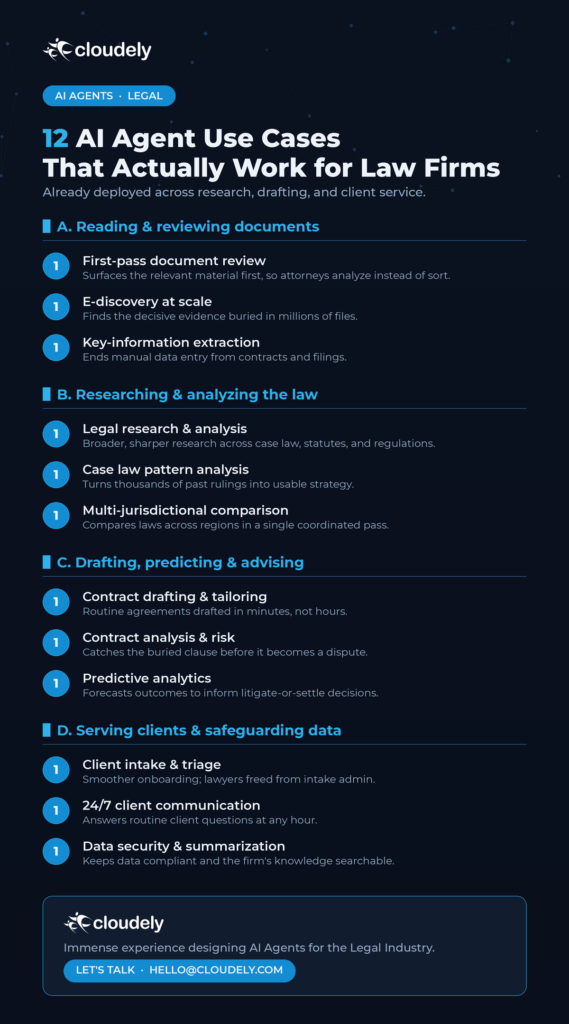
AI Agent Use Cases for Law Firms at a Glance
| S. No. | AI Agent Use Case | Primary Business Benefit |
| 1 | First-pass document review | Faster reviews with fewer errors |
| 2 | E-discovery at scale | Finds evidence traditional searches miss |
| 3 | Key information extraction | Eliminates manual data entry |
| 4 | Deep legal research | More comprehensive legal analysis |
| 5 | Case law pattern analysis | Converts precedent into legal strategy |
| 6 | Multi-jurisdictional comparison | Faster cross-border legal research |
| 7 | Contract drafting and tailoring | Hours of drafting reduced to minutes |
| 8 | Contract analysis and risk assessment | Identifies hidden legal risks early |
| 9 | Predictive analytics | Supports data-driven litigation strategy |
| 10 | Client intake and triage | Faster client onboarding |
| 11 | 24/7 client communication | Improves responsiveness and client satisfaction |
| 12 | Data management, security, and case summarization | Stronger compliance with faster knowledge retrieval |
What These AI Use Cases Mean for Modern Law Firms
Taken together, these twelve use cases highlight a significant shift in legal operations.
Rather than replacing lawyers, AI agents take ownership of repetitive, high-volume tasks such as document review, information extraction, legal research, contract drafting, summarization, and client communication.
This allows legal professionals to devote more time to:
- Strategic legal analysis
- Negotiation
- Client advisory
- Courtroom advocacy
- Complex legal reasoning
The result is a legal practice that is more efficient, more accurate, more scalable, and better equipped to deliver exceptional client experiences.
However, one principle remains unchanged.
AI-generated work should always be reviewed by qualified legal professionals. AI accelerates legal workflows, but legal judgment, ethics, and accountability continue to rest with experienced lawyers.
Frequently Asked Questions (FAQs)
Are these AI agent use cases already being implemented?
Yes. Law firms worldwide are already using AI agents for document review, legal research, contract analysis, predictive analytics, client communication, and knowledge management.
Which AI use case delivers the fastest ROI?
Document review and legal research typically deliver the quickest return because they involve repetitive, high-volume work that consumes substantial billable hours.
Can AI agents replace lawyers?
No. AI agents assist lawyers by automating repetitive tasks. Legal professionals remain responsible for legal interpretation, strategic decisions, ethical obligations, and client representation.
What technologies power legal AI agents?
Modern legal AI agents combine:
- Large Language Models (LLMs)
- Natural Language Processing (NLP)
- Retrieval-Augmented Generation (RAG)
- Workflow Automation
- Enterprise Knowledge Bases
- Secure integrations with legal practice management systems
These technologies enable AI agents to execute complete legal workflows rather than simply answering isolated questions.
Build AI Agents for Your Law Firm with Cloudely Inc.
At Cloudely Inc., we specialize in designing secure, enterprise-grade AI agents tailored for the legal industry.
Whether you’re looking to automate document review, accelerate legal research, streamline contract workflows, or improve client service, our AI solutions are built around your firm’s processes, compliance requirements, and security standards.
Start with a single high-impact use case or develop a comprehensive AI roadmap that transforms your legal operations.
Schedule a free consultation today. Email: hello@cloudely.com