
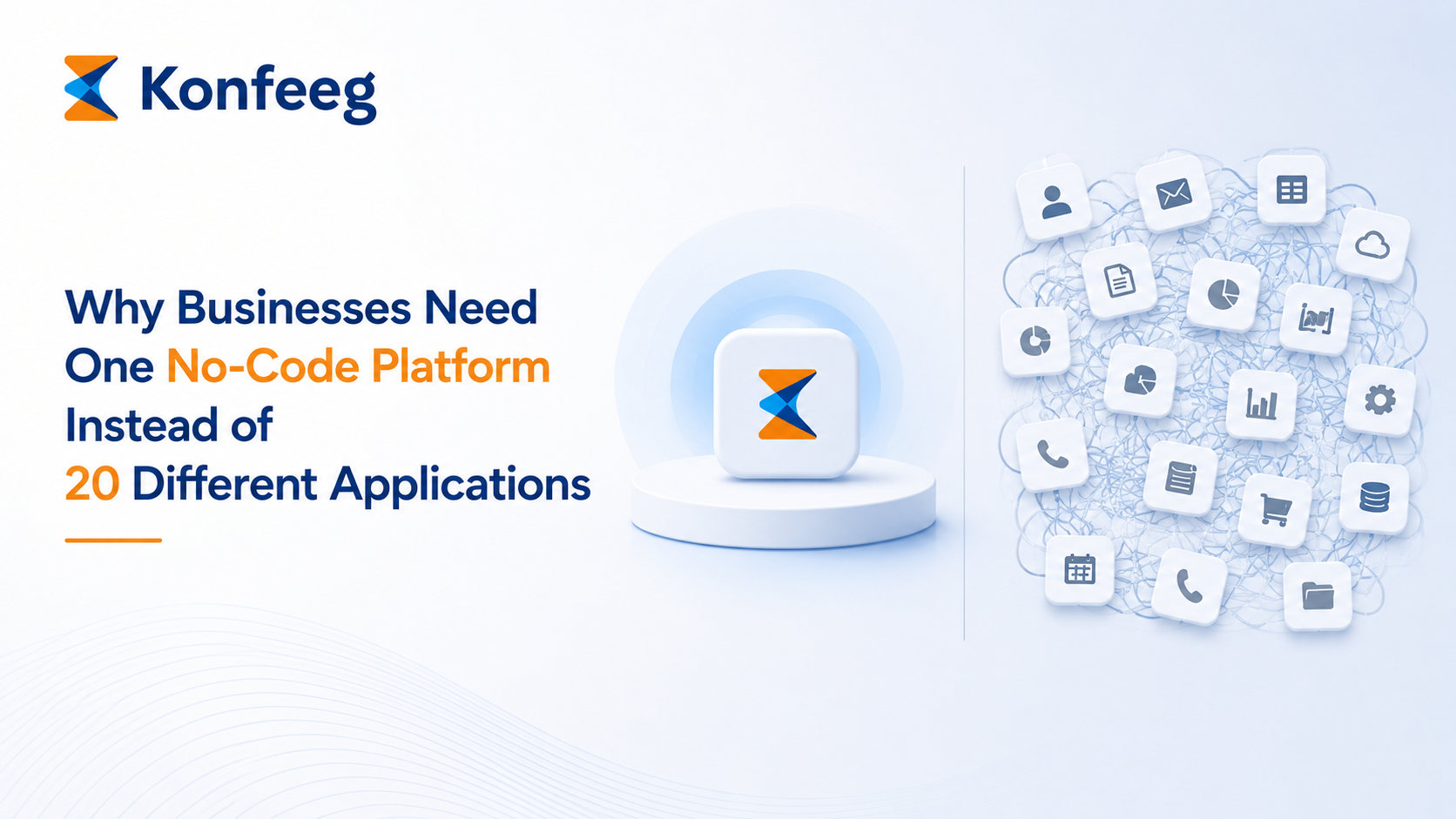
Enterprise software was meant to simplify business operations. Instead, for many organizations, it has become a growing source of complexity.
A CRM for sales. An HRMS for employee management. A separate application for contracts. Another for project management. Yet another for incident reporting. Add industry-specific software, employee engagement tools, partner portals, and countless spreadsheets, and the result is a fragmented technology landscape that is expensive to maintain and difficult to scale.
According to industry research, enterprises today use dozens of software applications across departments, each operating with its own workflows, user interfaces, and databases. While every application may solve a specific problem, together they create data silos, duplicate efforts, disconnected processes, and rising operational costs.
The challenge is no longer finding software to solve a business problem. The challenge is managing all the software already in place.
This is why organizations are rethinking their approach to enterprise technology. Instead of purchasing another application every time a new requirement emerges, they are investing in unified no-code platforms capable of supporting the entire enterprise.
The Growing Problem of Application Sprawl
Digital transformation has encouraged every department to adopt specialized software. Human Resources chooses one solution. Sales invests in another. Legal adopts a contract management platform. Operations deploys project management software.
Manufacturing implements industry-specific systems. Each decision makes sense independently. Collectively, they create an ecosystem that is increasingly difficult to govern.
Application sprawl introduces several challenges:
- Rising software licensing costs
- Duplicate and inconsistent business data
- Complex integrations between applications
- Multiple user identities and access controls
- Increased IT maintenance and support
- Poor visibility across departments
- Slower decision-making due to fragmented information
Ironically, organizations pursuing digital transformation often end up creating digital fragmentation.
Why Buying More Software Isn’t the Answer
When each new business requirement demands another software purchase, organizations become locked into an endless cycle of vendor management, software renewals, implementation projects, and system integrations.
The smarter approach is to adopt a platform that evolves with the business.
Instead of asking:
“Which software should we buy?”
Leading enterprises now ask:
“Can we build this capability on the platform we already have?”
That shift fundamentally changes how organizations approach technology investments.
From Business Applications to an Enterprise Operating System
Think about how an enterprise actually operates. A customer inquiry begins with Sales. The opportunity moves to Operations. Projects are assigned to delivery teams. Contracts are reviewed by Legal. Employees are onboarded through HR. Incidents are reported and resolved.
Partners collaborate on shared initiatives. Industry-specific operations continue running in manufacturing plants, farms, factories, or processing facilities.
Although these activities belong to different departments, they are all connected. Yet most organizations continue managing them on disconnected systems.
An Enterprise Operating System changes this completely.
Instead of isolated applications communicating through expensive integrations, every business function operates on the same platform, sharing common workflows, centralized governance, unified reporting, and a consistent user experience.
Technology stops becoming a collection of applications.
It becomes a connected business ecosystem.
What Should an Enterprise No-Code Platform Deliver?
A modern enterprise no-code platform should do far more than automate workflows.
It should enable organizations to rapidly build, deploy, and manage applications that support every business function without requiring extensive custom development.
The platform should provide:
- Unified data across departments
- Configurable workflows
- Role-based security
- Approval automation
- Business process digitization
- Centralized reporting and analytics
- Scalable architecture
- Industry-specific application support
- Rapid application development without coding
Most importantly, it should allow organizations to create new business applications whenever requirements change, without introducing another software vendor.
Konfeeg. One Platform. Multiple Enterprise Applications.
Konfeeg is designed around a simple principle. An enterprise should not have to purchase a different software product for every business function.
Instead, it should have one configurable platform capable of supporting enterprise-wide operations.
Today, organizations use Konfeeg to power applications across corporate functions and industry-specific operations.
| Business Function | Konfeeg Module |
| Human Resource Management | K-HRMS |
| Employee Self-Service | Employee Portal |
| Customer Relationship Management | K-CRM |
| Contract Lifecycle Management | K-CLM |
| Project Management | KPMS |
| Incident Management | KIMS (Konfeeg Incident Management System) |
| Concrete Quality Control | KKC |
| Agriculture Management | K-Agritech |
| Dairy Farm Operations | KDF |
| Dairy Enterprise Management | K-Dairy ERP |
| Textile ERP | K-Textiles |
| Employee Wellness | K-Wellness |
| Partner Collaboration | K-Partner Hub |
These are not standalone products stitched together over time. They are enterprise applications built on a common platform, sharing the same philosophy, architecture, and extensibility.
And because Konfeeg is a no-code platform, enterprises can continue building entirely new applications as business needs evolve.
Beyond Generic Workflows: Industry-Specific Applications Matter
Many no-code platforms focus primarily on horizontal business processes such as approvals, forms, or task management.
Modern enterprises require much more. A manufacturing company has different operational requirements than a dairy business.
An agriculture enterprise operates differently from a concrete plant. Industry-specific workflows cannot always be accommodated using generic software.
Konfeeg addresses this challenge by supporting both enterprise-wide applications and domain-specific solutions on the same platform.
Whether managing concrete quality control, dairy farm operations, textile manufacturing, agriculture workflows, or corporate business processes, organizations continue working within one connected ecosystem rather than introducing another isolated application.
This reduces complexity while allowing each business unit to retain the flexibility it needs.
Why Enterprise Leaders Are Choosing Unified Platforms
For CIOs, CTOs, and digital transformation leaders, success is no longer measured by the number of applications deployed.
It is measured by how effectively technology enables the business to operate.
A unified enterprise platform delivers measurable advantages:
Lower Technology Costs: Fewer software subscriptions reduce licensing expenses and vendor management overhead.
Faster Application Development: Business applications can be developed in weeks instead of months without extensive coding.
Better Governance: Centralized security, user management, and compliance simplify enterprise IT administration.
Connected Business Processes: Departments no longer operate in isolation. Information flows naturally across workflows.
Greater Business Agility: As new business requirements emerge, organizations build new applications on the same platform instead of investing in additional software.
Why Konfeeg Is More Than a No-Code Platform
Many no-code vendors focus on helping organizations build applications. Konfeeg focuses on helping enterprises build an entire digital ecosystem.
It enables organizations to consolidate enterprise functions, industry-specific operations, employee experiences, and partner collaboration on a single configurable platform.
Rather than replacing one software product, Konfeeg reduces the need for multiple disconnected systems by providing a foundation on which enterprises can continuously build, improve, and scale their business applications.
Whether the requirement is HR, CRM, contract management, incident reporting, project management, agriculture, dairy operations, textiles, quality control, or an entirely new custom application, the platform adapts to the organization’s evolving needs.
That is the difference between buying software and building enterprise capability.
The Future Isn’t More Software. It’s Fewer Platforms.
For years, digital transformation meant adding more technology. Today, it means simplifying it.
The enterprises leading the next wave of innovation will not be the ones with the largest collection of software applications. They will be the ones operating on unified platforms that eliminate silos, accelerate innovation, and adapt to changing business needs.
Every new business challenge does not require another software purchase. It requires a platform capable of evolving with the organization.
That is the role of an Enterprise Operating System. That is the vision behind Konfeeg.
Instead of managing twenty disconnected applications, enterprises can build, manage, and scale every business application on one unified no-code platform, creating a connected foundation for sustainable growth, operational excellence, and continuous innovation.
Ready to Simplify Your Enterprise Technology?
Whether you’re looking to digitize a single business process or build a connected ecosystem of enterprise applications, Konfeeg provides the flexibility, scalability, and speed to support your transformation journey.
Stop managing disconnected software. Start building your enterprise on one platform. Contact us today.